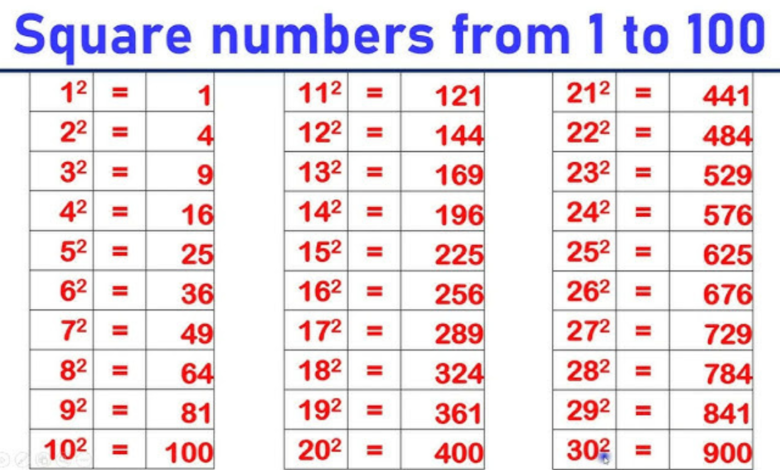
Square numbers are one of the most important building blocks in mathematics, forming the basis of many numerical patterns and calculations. A square number is created when a whole number is multiplied by itself, producing results that follow a predictable and structured pattern. Because of their simplicity and usefulness, square numbers are often introduced early in education and remain relevant throughout more advanced mathematical learning.
Understanding square numbers allows learners to recognise patterns, improve mental arithmetic, and solve practical problems more efficiently. From classroom exercises to real-life applications like measuring space or arranging objects, square numbers appear in many contexts. This article provides a complete guide, including definitions, examples, lists, and helpful insights to make the concept clear and engaging for all readers.
What Are Square Numbers
Square numbers, sometimes called perfect square numbers, are values obtained by multiplying an integer by itself. For example, when you multiply 4 by 4, the result is 16, which is a square number. This concept is often written using a small exponent, such as 4², which simply means 4 multiplied by itself. This notation is widely used in mathematics to simplify expressions.
The idea behind square numbers comes from geometry, where numbers can be arranged into equal rows and columns to form a perfect square shape. For instance, 9 can be arranged as a 3 by 3 grid, making it visually clear why it is a square number. This visual understanding helps learners connect numbers with shapes, making the concept more intuitive and easier to remember.
Examples of Square Numbers
Some of the most common square numbers include 1, 4, 9, 16, and 25. These are formed by multiplying numbers such as 1×1, 2×2, 3×3, and so on. These early examples are often taught to beginners because they are easy to memorise and demonstrate the pattern clearly. Recognising these values quickly can help improve confidence in mathematical problem-solving.
As numbers grow larger, the sequence continues with values like 36, 49, 64, 81, and 100. Each of these results follows the same rule, making square numbers predictable and easy to calculate. Observing the differences between consecutive square numbers reveals an interesting pattern, where the gaps increase steadily, offering deeper insight into how numbers behave.
Square Numbers List
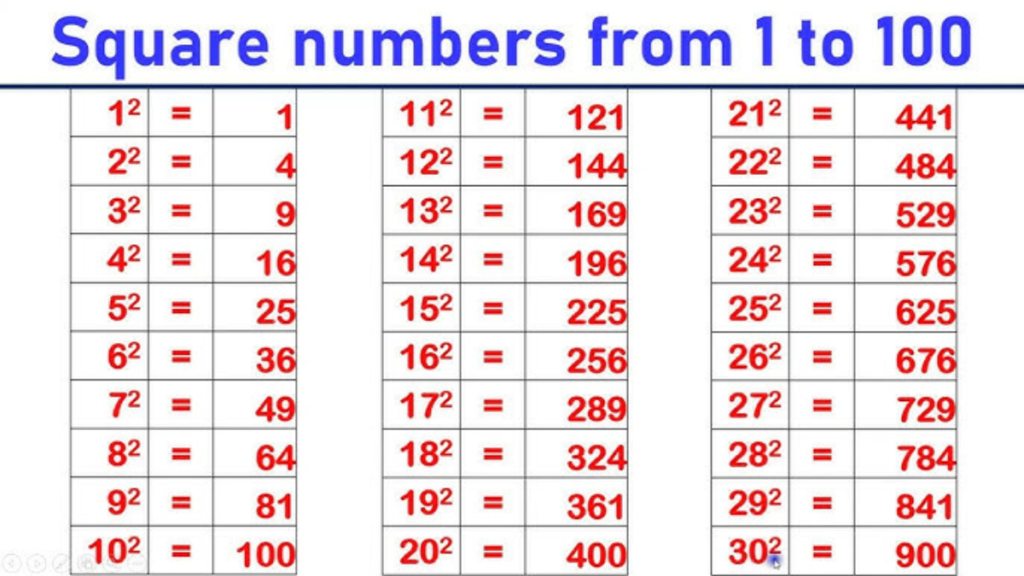
A square numbers list provides a clear overview of values created by squaring integers. The square numbers 1 to 100 include 1, 4, 9, 16, 25, 36, 49, 64, 81, and 100. These are commonly used in schools and exams, making them essential for students to memorise and understand thoroughly for quicker calculations.
Extending beyond this range, square numbers can be listed up to 1000 or even further. Learning a longer list helps improve number recognition and supports advanced topics such as algebra and geometry. By practising regularly, learners can quickly recall square numbers and apply them in various mathematical situations without hesitation.
Properties of Square Numbers
Square numbers have several interesting properties that make them unique. One key property is that they are always non-negative, meaning they are either zero or positive numbers. This is because multiplying two negative numbers results in a positive value, ensuring that square numbers never become negative.
Another important property is that the square root of a square number is always a whole number. Additionally, the difference between consecutive square numbers increases by odd numbers, creating a consistent pattern. These properties make square numbers easier to identify and help students understand deeper mathematical relationships.
How to Identify and Calculate Square Numbers
Calculating square numbers is straightforward, as it simply involves multiplying a number by itself. For example, to find the square of 7, you multiply 7 by 7 to get 49. This simple method forms the foundation for working with square numbers and is widely used in both basic and advanced mathematics.
Identifying square numbers can also be done by checking whether a number has a whole number square root. If it does, then it is a square number. With practice, learners can memorise common values and use mental maths techniques to recognise square numbers quickly, saving time and improving accuracy.
Real-Life Uses of Square Numbers
Square numbers are not just theoretical concepts; they have practical applications in everyday life. One of the most common uses is calculating the area of a square space, such as a room or a piece of land. By multiplying the length of one side by itself, you can determine the total area efficiently.
They are also used in design, construction, and technology. From arranging tiles in a grid pattern to understanding pixel layouts on screens, square numbers play a key role. Their practical value makes them an essential concept for both academic learning and real-world problem-solving.
Square Numbers Worksheets and Practice
Practising square numbers through worksheets is an effective way to strengthen understanding and improve skills. Worksheets often include exercises such as completing sequences, solving problems, and identifying missing values. These activities help reinforce learning and make the concept more familiar.
Regular practice also helps learners memorise square numbers and recognise patterns more quickly. By working through different types of questions, students can build confidence and prepare for more complex mathematical topics. Consistent practice ensures a solid grasp of square numbers over time.
Common Mistakes and Misconceptions
One common mistake is confusing square numbers with cube numbers. While square numbers involve multiplying a number by itself once, cube numbers involve multiplying it three times. This difference can lead to incorrect answers if not properly understood.
Another misconception is assuming that any large number is a square number. In reality, only numbers with whole number square roots qualify. Understanding these differences and practising regularly can help learners avoid errors and develop a clearer understanding of square numbers.
Conclusion
Square numbers are a simple yet powerful concept that plays an important role in mathematics. From their definition to their patterns and properties, they provide valuable insights into how numbers work. Learning square numbers helps build a strong foundation for more advanced topics.
By practising regularly and exploring their real-life applications, learners can develop confidence and improve their mathematical skills. Whether used in school or everyday situations, square numbers remain an essential part of understanding numbers and solving problems effectively.
Frequently Asked Questions
What are square numbers?
Square numbers are numbers formed by multiplying a number by itself.
What are the square numbers 1 to 100?
They include 1, 4, 9, 16, 25, 36, 49, 64, 81, and 100.
What are the first 5 square numbers?
The first five are 1, 4, 9, 16, and 25.
How do you identify square numbers?
Check if the number has a whole number square root.
What are perfect square numbers?
Perfect square numbers are another name for square numbers.
Why are square numbers important?
They help in calculations, patterns, and real-life measurements.
Also Read: Zoe Slater