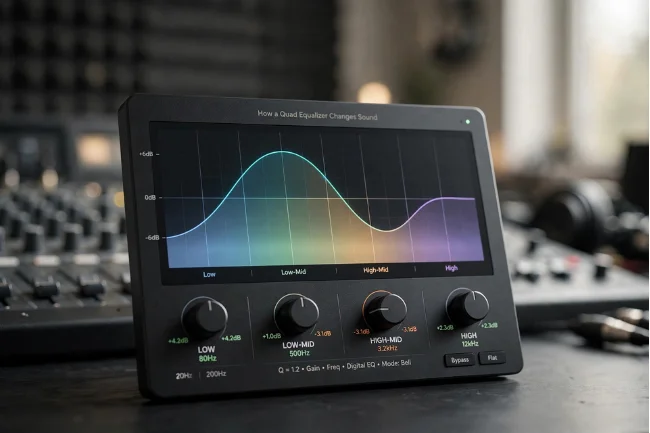
Introduction to Quad Equalizer
A quad equalizer is a term associated with audio equalization, a process that allows users to adjust different frequency ranges to improve the sound quality of music, recordings, and other audio content. Equalization plays an important role in modern audio systems because it gives listeners and sound professionals greater control over how sound is reproduced. By adjusting bass, midrange, and treble frequencies, an equalizer can make audio sound warmer, clearer, brighter, or more balanced.
The term “quad equalizer” may refer to an equalizer with four adjustable frequency bands, a particular audio component, or a product or platform using that name. Its exact meaning depends on the context in which it appears. In general, however, the concept connects to the broader purpose of equalization: shaping sound to suit personal preferences, room acoustics, speakers, headphones, and different types of audio material.
Understanding how a quad equalizer works can help beginners and experienced audio enthusiasts make better decisions about sound settings. Rather than simply increasing the volume, equalization changes the balance between frequencies, allowing users to emphasize or reduce specific elements of an audio signal.
What Is a Quad Equalizer?
A quad equalizer can be understood as an audio equalization system that provides four separate adjustment bands. Each band controls a particular portion of the audible frequency spectrum. The frequency ranges may be divided into low, low-mid, high-mid, and high frequencies, although the exact arrangement depends on the equipment or software.
The primary purpose of this type of equalizer is to provide straightforward control over sound characteristics without requiring users to manage dozens of individual frequency settings. A four-band arrangement can offer enough flexibility for everyday listening, basic music production, and simple audio adjustments.
For example, a listener who enjoys electronic music might want stronger bass, while someone listening to a podcast may prefer clearer speech. A quad equalizer can help users move toward these goals by adjusting the relevant frequency bands.
However, not every product described as a quad equalizer necessarily uses the same design. Some devices may offer four fixed controls, while others may allow users to select the center frequency or bandwidth of each adjustment. Checking the specifications of a particular product is important before assuming that it has specific features.
How Does a Quad Equalizer Work?
An equalizer changes the relative strength of selected frequencies in an audio signal. Sound contains many frequencies at the same time, and each frequency contributes to the overall listening experience.
Low frequencies generally create the feeling of bass and depth. Midrange frequencies carry much of the detail in vocals and many musical instruments. High frequencies contribute brightness, crispness, and certain subtle details.
A quad equalizer separates parts of this spectrum into adjustable bands. Increasing a band’s level makes the corresponding frequencies more prominent, while reducing the level makes them less prominent.
These adjustments are usually measured in decibels, commonly abbreviated as dB. A positive adjustment boosts a frequency range, while a negative adjustment cuts it. The amount of change determines how noticeable the effect may be.
For example, boosting low frequencies can make a song sound fuller. Reducing excessive midrange energy may help address a congested sound, while a modest high-frequency adjustment can add perceived brightness. The result depends on the original recording, the equipment, and the chosen settings.
Equalization does not automatically improve every recording. Excessive boosts can introduce distortion, increase unwanted noise, or make the overall sound less natural. Careful adjustments usually produce better results than making large changes across all four bands.
The Four Main Frequency Areas
Although frequency divisions vary between equalizer designs, a four-band equalizer can be used to control four broad areas of sound.
1. Low Frequencies
The low-frequency band affects bass instruments, kick drums, deep synthesizers, and the lower part of many musical recordings. It can help determine whether audio sounds thin, warm, powerful, or excessively heavy.
A moderate bass boost may benefit genres such as hip-hop, electronic dance music, and certain styles of rock. It can also make small speakers or headphones seem more substantial, although an equalizer cannot overcome the physical limitations of the equipment.
Too much bass may cause the sound to become muddy. It can also make vocals and other instruments seem less distinct, especially when the speakers or listening environment already emphasize low frequencies.
2. Low-Mid Frequencies
The low-midrange area contributes warmth and body to vocals, guitars, keyboards, and many acoustic instruments. It is important because it helps sounds feel full rather than thin or distant.
If this range is excessive, music may sound boxy, thick, or congested. Reducing it slightly can sometimes improve separation between instruments.
On the other hand, cutting too much low-midrange energy can make voices and instruments sound weak. The goal should be to correct a genuine imbalance rather than automatically reducing this band whenever the sound seems unclear.
3. High-Mid Frequencies
High-midrange frequencies contribute to speech intelligibility, vocal presence, guitar attack, and the definition of many instruments. Adjusting this range can make important details easier to hear.
A small boost may help vocals stand out in a dense musical arrangement. It can also make certain instruments feel more immediate and detailed.
However, excessive high-midrange energy can create a harsh or tiring listening experience. Some recordings already contain strong presence in this area, so additional boosting may make them less comfortable to hear.
4. High Frequencies
The high-frequency band influences brightness, cymbal detail, the sharpness of certain consonants, and the sense of openness in an audio recording.
Increasing this range may make a dull recording seem more lively. Reducing it can soften overly bright headphones, harsh recordings, or audio that contains distracting hiss.
Too much high-frequency boosting can exaggerate background noise and make cymbals or vocals sound sharp. A balanced setting should preserve useful detail without introducing unnecessary harshness.
Key Features of a Quad Equalizer
The features of a quad equalizer depend on the specific hardware or software, but several characteristics are commonly associated with four-band equalization.
Four-band frequency control: The main attraction is the ability to adjust four frequency areas independently. This provides more flexibility than a simple bass-and-treble control.
Straightforward operation: Four controls are relatively easy to understand, making this arrangement suitable for beginners who want to improve sound without learning advanced audio engineering techniques.
Personalized sound: Users can adapt audio to their preferences, whether they enjoy a bass-heavy presentation, balanced vocals, or a brighter sound.
Potential presets: Some digital equalizers include presets for music genres, spoken content, movies, or other listening situations. Presets are not guaranteed features of every quad equalizer.
Integration with audio equipment: Depending on the product, an equalizer may be built into a receiver, amplifier, car audio system, computer application, or digital audio processor.
Real-time adjustments: Many digital systems allow users to change equalizer settings while listening, making it easier to compare different sound profiles.
Before purchasing a specific device, users should verify whether it offers these features. The term alone does not establish the presence of presets, digital processing, connectivity options, or other advanced capabilities.
Benefits of Using a Quad Equalizer
One major benefit is improved control over the listening experience. Different recordings have different tonal characteristics, and an equalizer provides a way to adjust those differences without changing the entire audio system.
Another advantage is convenience. Four adjustment bands provide a manageable starting point for users who do not need the complexity of a professional graphic or parametric equalizer.
A quad equalizer can also help address certain tonal problems. For example, if headphones sound overly bright, a small reduction in the upper frequencies may make them more comfortable. If a recording sounds dull, a gentle high-frequency boost may improve its perceived clarity.
It can be useful for spoken content as well. Podcasts, interviews, and voice recordings may benefit from adjustments that make speech easier to understand. However, equalization cannot completely repair poor microphone placement, severe clipping, or heavily distorted recordings.
Another benefit is experimentation. Users can learn how different frequency ranges affect the sound of familiar songs. This practical experience helps build an understanding of audio production and makes future adjustments more intuitive.
Ultimately, the greatest advantage is flexibility. Instead of accepting a single fixed sound profile, users can adapt the tonal balance to their equipment, environment, and personal preferences.
Quad Equalizer vs. Other Types of Equalizers
A quad equalizer is one of several approaches to audio equalization. Comparing it with other designs helps explain when a four-band system may be appropriate.
Quad Equalizer vs. Graphic Equalizer
A graphic equalizer typically provides several frequency bands, each with a dedicated level control. Some models offer five, ten, fifteen, or more bands, allowing more detailed tonal adjustments.
A four-band equalizer generally offers fewer controls, which can make it easier to operate. However, it may not provide enough precision to address narrow frequency problems.
Quad Equalizer vs. Parametric Equalizer
A parametric equalizer commonly allows users to adjust the center frequency, gain, and bandwidth of individual filters. This provides precise control over particular frequency ranges.
A quad equalizer may be simpler if its bands are fixed. If its controls are fully parametric, the distinction depends on the implementation rather than the number of bands alone.
Quad Equalizer vs. Bass and Treble Controls
Basic bass-and-treble controls usually affect two broad portions of the frequency spectrum. A four-band system adds additional control over the middle frequencies.
This extra flexibility can be helpful when bass and treble adjustments alone cannot produce the desired tonal balance.
How to Set Up a Quad Equalizer
Setting up a quad equalizer begins with listening to the original sound. Before changing anything, play a familiar recording at a comfortable volume and identify what seems unbalanced.
First, check the source material and audio equipment. Poor-quality recordings, damaged speakers, and incorrect connections can create problems that equalization will not solve.
Next, start with a neutral setting if the equalizer provides one. A neutral starting point makes it easier to identify which changes are actually helpful.
Adjust one band at a time. If the bass sounds weak, try a small low-frequency boost. If vocals seem buried, consider whether a modest low-midrange reduction or high-midrange adjustment would help. If the recording sounds harsh, test a slight reduction in the upper frequencies.
Keep each change relatively small. Large adjustments can make a recording sound impressive for a moment but less balanced over time.
After each change, compare the adjusted sound with the original. Use the same volume when possible, because louder audio can seem better even when its tonal balance has not improved.
Finally, remember that the ideal settings may vary between recordings. A profile that works well for electronic music may not suit classical music, acoustic performances, or spoken-word content.
Common Mistakes to Avoid
One frequent mistake is boosting every frequency band. Raising all four bands does not necessarily improve sound quality and may increase the risk of clipping or distortion in the audio chain.
Another mistake is making adjustments based only on popular presets. Presets can provide useful starting points, but they are not guaranteed to work well with every headphone, speaker, room, or recording.
Users should also avoid assuming that more bass means better audio. Excessive low frequencies can mask other details and reduce clarity.
Ignoring the listening environment is another common problem. A room with strong bass resonances may need different adjustments from a room with limited low-frequency response. Headphones and speakers can also have different tonal characteristics.
Finally, an equalizer should not be treated as a replacement for good equipment or proper audio setup. It can refine sound, but it cannot restore information that is missing from a recording or completely eliminate physical limitations.
Who Should Use a Quad Equalizer?
A quad equalizer may be suitable for casual listeners who want greater control over their music. Its relatively simple layout can help beginners understand frequency balance without navigating a large collection of controls.
Music enthusiasts may appreciate the ability to create a preferred sound profile for different genres. People who listen through headphones, desktop speakers, or home audio systems may also find four-band adjustments useful when their equipment offers limited built-in tuning.
Content creators can use equalization as part of a broader audio workflow. Basic tonal adjustments may help voices sound more natural or reduce unwanted emphasis in a recording. More demanding production work, however, may require a parametric equalizer, compression, noise reduction, and other processing tools.
Car audio enthusiasts may also encounter four-band equalization as part of a stereo or digital sound-processing system. The actual usefulness depends on the controls available and the acoustic characteristics of the vehicle.
In every case, the important consideration is whether the equalizer offers the adjustments needed for the intended task.
Is a Quad Equalizer Worth Using?
Whether a quad equalizer is worthwhile depends on individual needs. For people who want a straightforward way to adjust bass, midrange, and treble characteristics, a four-band arrangement can provide a useful balance between simplicity and flexibility.
Users who require highly precise corrections may prefer a more advanced equalizer. Professional sound engineers often need detailed control over narrow frequency ranges, filter shapes, and other technical parameters.
Before choosing a specific product, consider the number of adjustable bands, available frequency ranges, control precision, compatibility with existing equipment, and whether the equalizer introduces unwanted noise or distortion.
It is also worth distinguishing between a general audio concept and a particular product named Quad Equalizer. If the term refers to a specific application, website, or device, its exact features and reputation should be evaluated using reliable product documentation rather than assumptions based on the name.
Conclusion
A quad equalizer offers a practical way to explore audio equalization through four adjustable frequency bands. By changing the balance between low, low-mid, high-mid, and high frequencies, users can shape the sound of music, speech, and other recordings according to their preferences.
Its main strengths are simplicity, flexibility, and ease of experimentation. Beginners can use it to learn the basics of frequency balance, while experienced listeners can make quick tonal adjustments to suit their equipment and listening environment.
However, good equalization requires restraint. Small, deliberate changes are usually more effective than aggressive boosts or cuts, and no single setting works perfectly for every recording.
Whether used for casual listening, basic audio production, or a home sound system, a quad equalizer can be a useful tool when its controls match the user’s needs. Understanding what each frequency band does is the first step toward making informed adjustments and achieving a clearer, more comfortable listening experience.