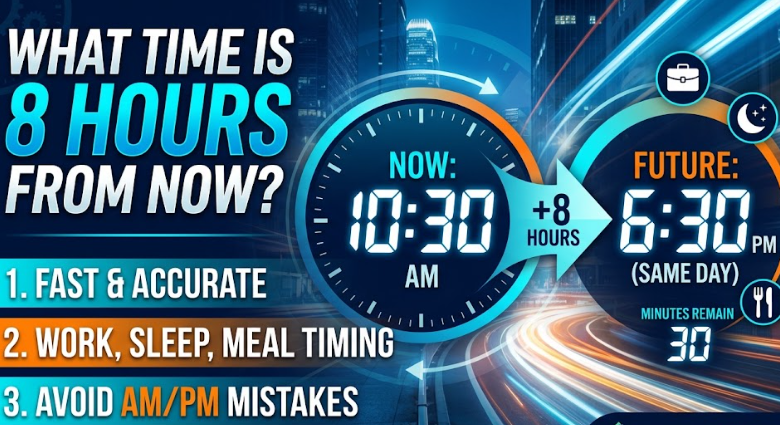
Have you ever wondered, what time will it be 8 hours from now? Perhaps you are planning your work schedule, waiting for an important event, setting a reminder, or figuring out when you should go to sleep. Calculating the time eight hours into the future is a simple task, but it can become confusing when midnight, different time zones, or changes in your daily routine are involved.
Understanding how to calculate future time can help you organize your day more effectively. Instead of repeatedly checking the clock or using a calculator, you can learn a simple method that works in almost every situation. Whether you use a 12-hour clock with AM and PM or a 24-hour clock, adding eight hours is easy once you understand the basic rules.
In this article, we will explain how to calculate eight hours from the current time, explore practical examples, discuss common mistakes, and show how this calculation can help with work, travel, sleep, and everyday planning.
What Time Will It Be 8 Hours From Now?
The answer depends on the current time in your location. To find the future time, simply add eight hours to the time shown on your clock.
For example, if the current time is 9:00 AM, adding eight hours gives you 5:00 PM on the same day. If it is 2:00 PM, eight hours later will be 10:00 PM. However, if the current time is 8:00 PM, adding eight hours takes you past midnight to 4:00 AM the following day.
Here are a few examples:
- 6:00 AM + 8 hours = 2:00 PM.
- 8:00 AM + 8 hours = 4:00 PM.
- 10:00 AM + 8 hours = 6:00 PM.
- 12:00 PM + 8 hours = 8:00 PM.
- 3:00 PM + 8 hours = 11:00 PM.
- 5:00 PM + 8 hours = 1:00 AM the next day.
- 9:00 PM + 8 hours = 5:00 AM the next day.
These examples demonstrate that the calculation is straightforward. The only additional step is recognizing when the result falls on the next calendar day.
How to Calculate 8 Hours From the Current Time
You do not need a special application or advanced mathematical skills to calculate eight hours from now. what time will it be 8 hours from now A basic understanding of the clock is enough.
Check the Current Time
Begin by looking at your phone, computer, wristwatch, or another reliable clock. Make sure you know whether the time is in the morning or afternoon if you are using a 12-hour clock.
For instance, suppose your clock displays 11:00 AM. This is your starting point.
Add Eight Hours
Move forward eight hours from the starting time. You can count hour by hour or add eight directly.
Starting at 11:00 AM, the calculation looks like this:
12:00 PM, 1:00 PM, 2:00 PM, 3:00 PM, 4:00 PM, 5:00 PM, 6:00 PM, and 7:00 PM.
Therefore, eight hours after 11:00 AM is 7:00 PM.
Check Whether the Day Changes
If the calculation crosses midnight, the final time belongs to the following day.
For example, starting at 10:00 PM:
- Two hours later, it is midnight.
- Six additional hours bring the clock to 6:00 AM.
The final answer is 6:00 AM the next day.
This final step is particularly important when planning appointments, work shifts, medication reminders, or travel arrangements.
Understanding the 12-Hour Clock
The 12-hour clock is widely used in everyday conversations. It divides the day into two periods: AM and PM.
AM generally refers to the period from midnight until just before noon. PM covers the period from noon until just before midnight.
When adding eight hours, you must pay attention to these labels because the same number can represent different times of day.
For example, eight hours after 7:00 AM is 3:00 PM. However, eight hours after 7:00 PM is 3:00 AM the following day.
The numbers on the clock may look similar, but the AM or PM designation changes the meaning.
A useful technique is to separate the calculation into two parts. First, determine the hour by adding eight. Then identify whether the result falls in the morning or afternoon.
If the starting time is 4:00 AM, adding eight hours gives noon. If the starting time is 4:00 PM, adding eight hours gives midnight.
Remember that 12:00 AM means midnight, while 12:00 PM means noon. This distinction prevents many common scheduling mistakes.
Calculating Eight Hours Using the 24-Hour Clock
The 24-hour clock is another convenient way to calculate future time. It is commonly used in transportation schedules, hospitals, workplaces, military settings, and international travel.
Instead of restarting at 1:00 after noon, the 24-hour clock continues counting through 13:00, 14:00, 15:00, and beyond.
For example:
- 06:00 + 8 hours = 14:00.
- 09:00 + 8 hours = 17:00.
- 12:00 + 8 hours = 20:00.
- 15:00 + 8 hours = 23:00.
- 18:00 + 8 hours = 02:00 the next day.
- 21:00 + 8 hours = 05:00 the next day.
When the result reaches 24:00, the clock starts again at 00:00 on the following day.
For example, 20:00 plus eight hours equals 04:00 the next day. In the 12-hour format, this is 4:00 AM.
The 24-hour system can be especially useful when you want to avoid confusion between morning and evening.
What Happens When Eight Hours Cross Midnight?
Crossing midnight is one of the most common reasons people become confused when calculating future time.
Midnight marks the beginning of a new calendar day. If you add eight hours to a late-evening time, the answer may fall on the following morning.
Consider a few examples:
| Starting time | Time eight hours later |
|---|---|
| 4:00 PM | 12:00 AM next day |
| 5:00 PM | 1:00 AM next day |
| 6:00 PM | 2:00 AM next day |
| 7:00 PM | 3:00 AM next day |
| 8:00 PM | 4:00 AM next day |
| 9:00 PM | 5:00 AM next day |
| 10:00 PM | 6:00 AM next day |
| 11:00 PM | 7:00 AM next day |
Notice that the clock returns to the beginning of the day after midnight. The number of hours remains the same, even though the calendar date changes.
This matters whenever you schedule something for tomorrow morning or need to calculate the end of a night shift.
For example, if a delivery is expected eight hours after 9:00 PM, you should expect it at 5:00 AM the next day, assuming the schedule is based on ordinary elapsed time.
Why Do People Search for What Time Will It Be 8 Hours From Now?
People search for this question for many practical reasons. Time calculations are part of everyday life, and knowing the answer can make planning easier.
Work and Office Schedules
An eight-hour period is commonly associated with a standard workday. Employees may want to calculate when they will finish work after starting a shift.
For instance, someone who begins working at 8:30 AM and works for eight hours will reach 4:30 PM, excluding unpaid breaks. If a lunch break is not included in the eight working hours, the actual finishing time may be later.
Calculating the end time helps employees organize meetings, plan transportation, and manage responsibilities after work.
Sleep and Rest
Sleep planning is another reason people calculate eight hours into the future. Someone preparing for bed may want to know when eight hours will have passed.
If you go to sleep at 10:30 PM, eight hours later is 6:30 AM. This calculation can help establish a consistent morning routine.
However, the time eight hours later is not a guarantee that you will receive eight hours of sleep. The actual amount depends on how long it takes you to fall asleep and whether you wake during the night.
Travel and Transportation
Travelers often calculate future times to estimate arrivals, departures, and connections. An eight-hour journey beginning at 7:00 AM would finish at approximately 3:00 PM if the journey takes exactly eight elapsed hours.
Real journeys may take longer because of traffic, delays, stops, or changes in transportation schedules. When crossing time zones, you must also account for the local time at your destination.
Cooking and Household Tasks
Some household activities require waiting a specific number of hours. A person might need to leave something to rest, refrigerate an item, or check a process after a set interval.
If a task begins at 1:00 PM and requires eight hours, the check time is 9:00 PM.
Using a timer or reminder can help you avoid forgetting the task, especially when you are busy with other responsibilities.
Online Events and Appointments
Online meetings, gaming sessions, livestreams, and virtual appointments can also involve future-time calculations.
If an event is scheduled eight hours after a particular starting point, calculating the time correctly helps you prepare. When participants live in different countries, make sure everyone is using the intended time zone.
How to Calculate Eight Hours From Now in Different Time Zones
Time zones introduce another layer of complexity. Eight hours of elapsed time is still eight hours, but the displayed local time can differ depending on where you are.
For example, if it is 10:00 AM in your location, eight hours later in that same location will be 6:00 PM. If you are arranging a call with someone overseas, however, their local clock may show a different time.
To calculate accurately, follow these steps:
- Identify your current local time and time zone.
- Add eight hours to determine the future instant.
- Convert that instant to the other person’s time zone if necessary.
- Check whether the calendar date changes at either location.
Daylight saving time can also affect local clock calculations in regions that observe it. If the period crosses a clock change, eight elapsed hours may not always correspond to an eight-hour difference between the displayed local clock readings.
For ordinary daily planning, simply adding eight hours to your local clock is usually sufficient. For international meetings, flights, or time-sensitive arrangements, a reliable world clock or calendar application is safer.
Common Mistakes to Avoid When Adding Eight Hours
Although adding eight hours is simple, several mistakes can lead to incorrect results.
Forgetting the Next Day
One common error is calculating the correct hour but forgetting that the date has changed. For example, 8:00 PM plus eight hours is 4:00 AM tomorrow, not 4:00 AM today.
Confusing AM and PM
Another mistake is selecting the right number but the wrong half of the day. Always check whether the answer belongs to the morning or evening.
Ignoring Breaks at Work
An eight-hour work shift may not always mean that you can leave exactly eight hours after arriving. Unpaid breaks may extend the total time you spend at work.
Overlooking Time Zones
If you are calculating an event for another country, do not assume its clock matches yours. Confirm the destination’s time zone before finalizing plans.
Treating Approximate Times as Exact
If your starting time is 9:15 AM, the result is 5:15 PM. If the starting time includes seconds, those seconds also remain part of the calculation unless the time is rounded.
For example, 9:15:30 AM plus eight hours is 5:15:30 PM.
Paying attention to these details makes time calculations more dependable.
Can You Calculate Eight Hours From Any Starting Time?
Yes. The same method works regardless of whether the starting time is early in the morning, around noon, in the evening, or close to midnight.
For instance, if the current time is 2:45 PM, eight hours later will be 10:45 PM. If the current time is 6:20 PM, the result will be 2:20 AM the next day.
You can also calculate times that include minutes. Simply keep the minutes unchanged when adding a whole number of hours.
The general rule is straightforward: adding eight hours changes the hour but does not change the minutes or seconds. The date changes only when the calculation crosses midnight.
For a quick mental calculation, divide the eight-hour period into smaller blocks. Adding four hours twice, or adding six hours followed by two more, can make the calculation easier when starting from a time that is difficult to visualize.
For recurring schedules, a phone calendar, digital clock, or reminder application can automate the process.
Final Thoughts
Knowing what time will it be 8 hours from now is useful for managing work, sleep, travel, household responsibilities, and appointments. The calculation is simple: take your current local time and add eight hours, remembering to move to the next day if the result passes midnight.
For example, 8:00 AM becomes 4:00 PM, 1:00 PM becomes 9:00 PM, and 10:00 PM becomes 6:00 AM the following day.
The 12-hour clock works well for everyday use, while the 24-hour clock can make scheduling more precise. When dealing with international events or daylight saving changes, confirm the relevant time zone before relying on the result.
Ultimately, a small understanding of time arithmetic can make everyday planning much easier. Whether you are arranging a work shift, preparing for bed, or setting a reminder, adding eight hours is a quick skill that helps you stay organized and manage your time with greater confidence.