The Benetton F1 team is widely recognised as one of the most influential and iconic teams in Formula 1 history. Founded by the Italian Benetton family, known primarily for their global clothing brand, the team made its official debut in 1986. Combining commercial ambition with sporting innovation, Benetton quickly developed a reputation for ingenuity, competitiveness, and a willingness to push the boundaries of technology in the sport.
Over its 15-year presence in Formula 1, the Benetton F1 team became a household name, particularly during the early to mid-1990s. Its combination of skilled drivers, innovative car designs, and strategic leadership allowed it to compete against more established teams. Fans across the UK and Europe remember Benetton for its distinctive liveries, memorable races, and the talent it nurtured, leaving a lasting impact on motorsport.
Benetton F1 Team History
The Benetton F1 team history began in the mid-1980s when the Benetton family decided to enter Formula 1. Initially, the team acquired the Toleman team’s assets, allowing them to participate in the 1986 season. While early results were modest, the team quickly learned the intricacies of F1 engineering and racing strategy, building a strong foundation for future success.
By the early 1990s, the Benetton F1 team had established itself as a major contender. With innovative engineering, sponsorship from leading brands, and skilled personnel, the team won multiple races and eventually claimed both drivers’ and constructors’ championships. The evolution from a mid-field team to a championship-winning force demonstrates Benetton’s dedication and strategic vision in Formula 1.
Iconic Drivers and Team Principals
The Benetton F1 team is closely associated with legendary drivers like Michael Schumacher, Nelson Piquet, and Riccardo Patrese. Schumacher’s debut with the team in the early 1990s marked a turning point, as his exceptional skill combined with the team’s engineering prowess led to multiple victories and championship success. Drivers like Piquet and Patrese also contributed to the team’s competitive legacy.
Leadership was equally important in the success of the Benetton F1 team. Team principals guided technical development, strategic decisions, and race-day management, ensuring that the team remained competitive. The principals’ ability to manage both talent and technology was critical, influencing the team’s long-term performance and helping establish Benetton as a respected constructor in the world of Formula 1.
Memorable Cars and Logos
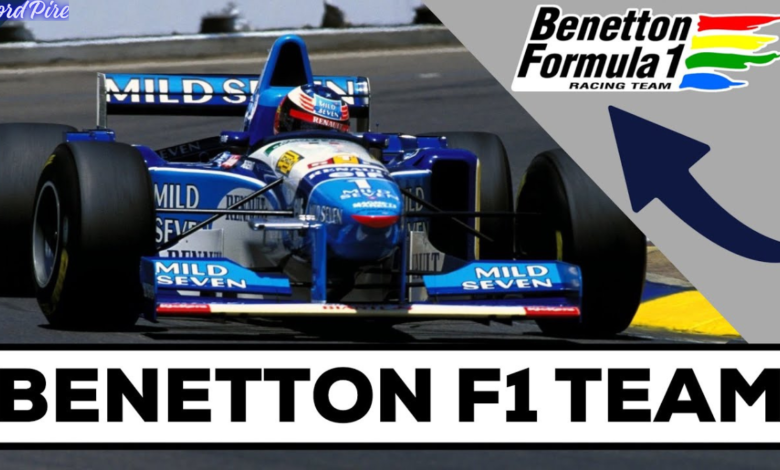
The cars of the Benetton F1 team are celebrated for their technical innovation and distinctive design. Models such as the B186, B194, and B201 were renowned for their speed, aerodynamics, and reliability. Each car represented the team’s commitment to pushing engineering boundaries, contributing to numerous podiums and championship victories over the years.
Equally iconic was the Benetton F1 team logo, which became a symbol of style and performance in Formula 1. Featuring the company’s distinctive colours and branding, the logo helped the team stand out on the grid. Fans and collectors still recognise the logo as a representation of the team’s racing success and its broader impact on motorsport culture.
Controversies and Challenges
The Benetton F1 team faced several controversies, the most notable being the 1994 cheating scandal. Accusations regarding irregularities with car electronics and regulations cast a shadow over the team’s championship that year. Despite the controversy, Benetton managed to maintain competitive performance, demonstrating resilience and determination in the highly scrutinised environment of Formula 1.
Beyond scandals, the Benetton F1 team had to navigate evolving technical regulations, strong competition, and changing sponsorship landscapes. These challenges tested the team’s adaptability and innovation. The ability to overcome these obstacles while remaining competitive highlighted Benetton’s skill, strategic thinking, and contribution to Formula 1’s evolution during the 1980s and 1990s.
Transition and What Happened to the Benetton F1 Team
In 2000, the Benetton F1 team underwent a major transition when the Renault Group purchased the team. This marked the end of Benetton as an independent constructor in Formula 1, though its legacy continued under Renault’s banner. Several former drivers, engineers, and managers carried forward the lessons and experience gained from Benetton into their new roles.
Today, the Benetton F1 team is remembered for its pioneering achievements and contribution to the sport. While it no longer competes under its original name, the team’s history, drivers, and cars remain highly respected. Fans and historians continue to celebrate Benetton’s influence on racing strategy, car design, and driver development, ensuring the team’s enduring legacy.
Legacy and Impact on Formula 1
The legacy of the Benetton F1 team goes beyond race wins and championship titles. The team introduced innovations in car aerodynamics, engine performance, and race strategy that influenced the wider F1 landscape. Many modern teams adopt similar approaches to engineering, talent management, and sponsorship thanks to Benetton’s early examples of innovation.
Fans continue to celebrate the Benetton F1 team for its bold colours, iconic liveries, and memorable moments on the track. Its combination of competitive spirit, technical innovation, and star drivers has left a permanent imprint on Formula 1 history. Benetton remains a symbol of how ambition and vision can create a lasting motorsport legacy.
Conclusion
The story of the Benetton F1 team is one of ambition, innovation, and resilience. From its early struggles to championship triumphs and eventual transition to Renault, the team’s journey reflects determination and strategic thinking. Its drivers, cars, and management have influenced the sport for decades, ensuring that the name Benetton continues to resonate in Formula 1 history.
Frequently Asked Questions
What was the role of the Benetton F1 team principal?
The team principal directed strategy, driver management, and car development, playing a crucial role in team success and championship wins.
What happened to the Benetton F1 team after 2001?
The team was sold to Renault, marking the end of the Benetton era, while its legacy and expertise influenced the new constructor.
Which drivers made the Benetton F1 team famous?
Michael Schumacher, Nelson Piquet, and Riccardo Patrese were among the team’s most celebrated drivers, contributing to multiple race victories and championships.
What was the 1994 Benetton F1 team controversy?
The team faced accusations of rule-breaking, specifically regarding car electronics, which sparked major scrutiny during Schumacher’s championship season.
Where is the Benetton F1 team logo now?
The logo is recognised globally as part of motorsport history, symbolising innovation, competition, and the team’s racing legacy.
Also Read: Mt Everest Second Step