
Purchasing Bitcoin (BTC) with Canadian dollars (CAD) has become a common financial transaction for users living in Canada or earning income in CAD. While cryptocurrency was once perceived as a separate, almost closed system, today it is increasingly integrated into regular money flows, alongside currency exchanges and international transfers. Interest in Bitcoin in the Canadian currency zone is largely due to the CAD’s stable use in investments, savings, and online payments. At some point, many users face the logical step of converting some of their funds into BTC. This allows them to take advantage of the advantages of digital assets: independence from banking restrictions, global accessibility, and the ability to store capital on a decentralized network.
However, the purchase process itself can vary. Some choose complex trading platforms, others use banking services with crypto access, and others prefer the most direct method – exchanging CAD for BTC through specialized services. The difference between them often lies not in the outcome, but in the number of steps required to receive Bitcoin cryptocurrency.
What happens when you buy BTC for CAD
If you consider the process without reference to a specific platform, buying Bit Coin for Canadian dollars always follows the same principle: exchanging fiat currency for a digital asset, followed by crediting it to the user’s crypto wallet. However, the path to this result can vary in structure. In some cases, the user works through exchange orders, in others through automatic conversions or payment services. But the end result is always the same: CAD is converted into BTC at the current market rate. In practice, the transaction usually involves several key elements:
- source of funds in Canadian dollars (card, account, payment service);
- selected conversion rate;
- Bitcoin network for sending assets;
- user’s crypto wallet;
- service performing the exchange.
The fewer intermediaries between CAD and BTC, the faster the cryptocurrency is received.
What approaches are used to buy Bitcoin?
There are several common models for purchasing BTC with Canadian dollars. They differ not only in their interface but also in the overall logic of interacting with cryptocurrency. Some users prefer exchanges, where they can place orders and choose their entry price. This approach is more suitable for those who monitor the market and plan their purchases more strategically. Others use banking and fintech apps, where cryptocurrency is integrated as an additional feature. These apps typically simplify the process as much as possible, but offer less flexibility in choosing terms. There are also services that operate on a direct conversion principle. With them, the user immediately sees the total amount of Bitcoin for a certain amount of CAD and completes the exchange without any trading operations.
The main approaches are:
- Purchasing through cryptocurrency exchanges;
- Using fintech apps that support BTC;
- Banking services with crypto functionality;
- Direct exchange platforms;
- P2P transactions between users.
Each option solves a single problem, but with varying degrees of user involvement.
Why is simplicity important when buying BTC for CAD?
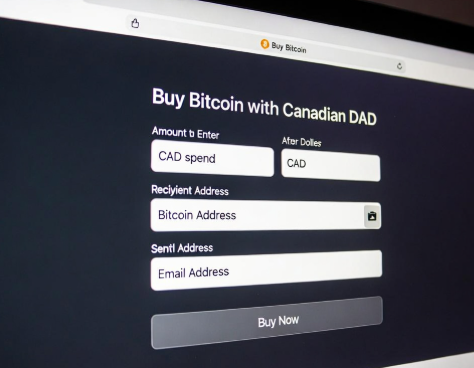
Despite the development of the cryptocurrency infrastructure, many users are reluctant to delve deeply into the trading mechanics. They prioritize getting the result—Bitcoin in their wallet—without learning complex interfaces and financial instruments. This is why solutions that reduce the purchase process to just a few steps are gaining increasing attention. This is especially relevant for those who use cryptocurrency occasionally or are new to the market.
The most commonly valued features are:
- minimal number of steps;
- clear calculation of the final BTC amount;
- no need to trade;
- fast transfer of funds to the wallet;
- support for popular payment methods;
- predictability of results;
- accessibility for beginners.
In this context, buying Bitcoin becomes closer to a regular currency exchange than an investment transaction.
The role of electronic exchangers in buying Bitcoin
Among all the methods for acquiring BTC for Canadian dollars, electronic exchangers occupy a special place. Their main idea is to eliminate unnecessary steps between the sending and receiving currencies. Instead of navigating trading charts or creating orders, users simply select a direction, enter the amount, and receive payment. After payment, the Bitcoin is sent to the specified wallet. This format is especially convenient when the goal is conversion rather than active trading.
The advantages of exchange services typically include:
- direct conversion of CAD to BTC;
- quick application process;
- lack of complex trading tools;
- clear transaction structure;
- convenience for one-time purchases;
- time savings;
- receiving Bitcoin directly to a wallet.
Because of this, exchangers are often used as the easiest entry point into cryptocurrency.