Meryl Streep Discusses Melania Trump’s Controversial Jacket With Anna Wintour: What the Fashion Moment Really Meant

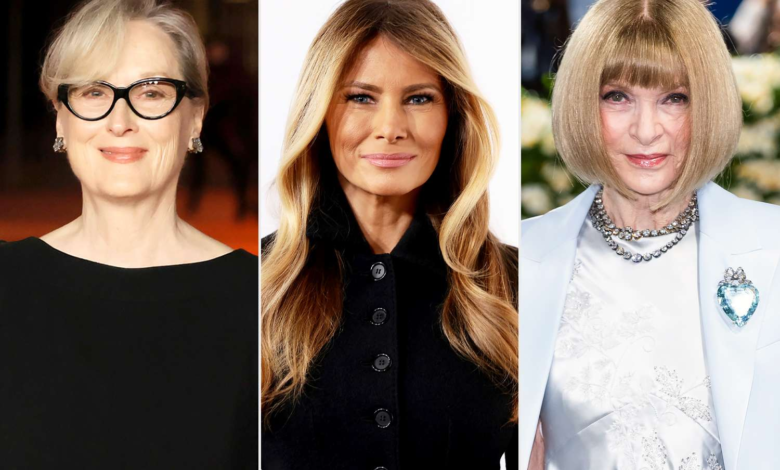
The worlds of Hollywood, fashion, and politics often collide in ways that create conversations far beyond the original event. Few moments demonstrate that better than the discussion surrounding Melania Trump’s controversial jacket and the wider debate about what public figures communicate through clothing. The topic became especially interesting because it brought together two very different cultural perspectives: the political symbolism associated with Melania Trump’s wardrobe and the fashion expertise represented by Anna Wintour.
meryl streep discusses melania trump’s controversial jacket with anna wintour name entering that conversation adds another layer of intrigue. Known for her long career, carefully chosen roles, and willingness to speak publicly about cultural and political issues, Streep has frequently been part of discussions that go beyond the entertainment industry. When her perspective is connected with Anna Wintour, one of fashion’s most influential figures, the subject naturally attracts attention from people interested in celebrity culture, politics, media, and style.
However, conversations about high-profile fashion moments can easily become distorted as they travel across social media and online publications. A headline may suggest a direct exchange or dramatic revelation when the broader context is more complicated. That is why understanding the background of Melania Trump’s jacket controversy, the role of Anna Wintour in fashion commentary, and Meryl Streep’s public image is important when examining the story.
Why Melania Trump’s Jacket Became Such a Major Talking Point
Melania Trump’s fashion choices have attracted significant attention throughout her years in the public spotlight. As a former model and First Lady of the United States, she occupies a unique position in American public life. Every outfit she wears at a major event can be photographed, analyzed, and interpreted as a potential statement, even when the intention behind it may simply be personal style.
The jacket controversy most commonly associated with Melania Trump involves a green Zara jacket bearing the words, “I REALLY DON’T CARE, DO U?” She wore it in 2018 while traveling to visit children separated from their parents at the U.S.-Mexico border. The timing immediately sparked criticism because many people interpreted the message as insensitive to the humanitarian situation surrounding the trip.
The controversy became larger than the jacket itself. Supporters and critics debated whether the garment was intentionally provocative, a careless fashion decision, or a deliberate attempt to challenge the media narrative surrounding Melania Trump. Her communications team later indicated that the jacket was not intended to send the message many people assumed it did, while Melania herself suggested that critics were focusing too heavily on her clothing.
That tension between intention and interpretation is at the heart of the controversy. Public figures do not always control how their clothing is understood, especially when they appear in politically charged environments. A simple fashion choice can become symbolic because of the person wearing it, the location, and the circumstances surrounding the appearance.
The Role of Fashion in Political Communication
Fashion has always played a role in public communication, particularly for political figures. Clothing can signal professionalism, patriotism, rebellion, tradition, or modernity without a single word being spoken. This is one reason First Ladies and other prominent political figures often receive intense scrutiny for their wardrobes.
For someone like Melania Trump, the attention is amplified by her background in fashion. Her clothing choices are frequently examined for designer labels, colors, silhouettes, and cultural references. The public often looks for hidden meanings in those choices, sometimes treating an outfit as a carefully constructed political message.
Yet fashion interpretation is not an exact science. The same garment can communicate completely different things to different audiences. A color that symbolizes optimism to one person might represent political resistance to another. A slogan intended as a personal joke might be interpreted as a statement about a national crisis.
This is where the expertise of fashion commentators such as Anna Wintour becomes relevant. Wintour has spent decades shaping conversations about style and culture, but fashion journalism also recognizes that clothing exists within a larger social context. A garment’s meaning is influenced by timing, setting, history, and the public identity of the person wearing it.
Why Anna Wintour’s Perspective Carries So Much Weight
Anna Wintour is one of the most recognizable names in modern fashion. Her career has been closely associated with Vogue and with the broader transformation of fashion magazines into powerful cultural institutions. Over the years, she has become known not only for her influence over designers and trends but also for her opinions about celebrity culture, politics, and public image.
Because of that reputation, Wintour’s involvement in conversations about Melania Trump’s controversial jacket naturally attracts attention. She represents a fashion industry perspective that often looks beyond whether an outfit is simply attractive. The fashion world frequently considers how clothing interacts with identity, power, branding, and social circumstances.
Wintour’s perspective is particularly interesting when discussing a political figure because fashion has become an important part of political storytelling. Politicians and their families understand that appearances matter, and professional stylists often help create visual identities that can influence how the public perceives them.
At the same time, Wintour’s involvement should not automatically be interpreted as proof that every claim circulating online about the jacket is accurate. Celebrity discussions can quickly become simplified, and quotes are sometimes repeated without enough context. The safest approach is to distinguish between confirmed statements, reported commentary, and interpretations created by audiences.
Where Meryl Streep Fits Into the Conversation
Meryl Streep brings a very different perspective to discussions about public figures and political symbolism. As one of the most respected actors of her generation, she has built a reputation for thoughtful performances and for speaking openly about issues she considers important.
Streep has also been publicly involved in political and cultural conversations. Her 2017 Golden Globes speech, for example, became widely discussed because of her criticism of political behavior and her defense of empathy and journalism. That speech reinforced her public image as someone willing to use her platform to address broader social concerns.
Because of this history, the idea of Meryl Streep discussing a controversial political fashion moment with someone like Anna Wintour is inherently compelling. It combines Hollywood, fashion, media, and politics in a single conversation. However, it is important not to assume that every online headline accurately represents the exact details of a private or public discussion.
When a story involves several famous personalities, readers should pay attention to the wording. There is a meaningful difference between saying that someone “discussed” a subject, “commented on” it, or was simply connected to a conversation where the subject was mentioned. Those distinctions matter, especially when the original source is unclear.
The Difference Between Fashion Criticism and Political Criticism
One reason the jacket controversy became so intense was that it existed at the intersection of fashion and politics. Critics were not simply saying they disliked the jacket. They argued that the choice was inappropriate because of the context in which it was worn.
This raises an important question about the responsibilities of public figures. When someone holds a highly visible position, should every fashion decision be treated as a form of communication? Many people believe the answer is yes, particularly when the person is visiting a location connected to a major political controversy.
Others argue that this expectation can become unfair. Public figures are human beings who sometimes make ordinary clothing choices without intending to send a coded message. The assumption that every outfit is politically calculated can create an environment where even minor details become subjects of controversy.
The disagreement is ultimately about perception. Once an image is captured and distributed globally, the person wearing the clothing may lose control over its meaning. In the case of Melania Trump’s jacket, the words were visible enough to become the center of the story, regardless of what she intended when she put it on.
Why the Controversy Continues to Resurface
The jacket controversy remains memorable because it represents a broader era of intense political polarization. During periods of heightened political conflict, symbols become especially powerful. People search for meaning in speeches, gestures, photographs, and even fashion choices.
The jacket also became an example of how quickly a single image can dominate a news cycle. Instead of focusing entirely on the broader issue surrounding the border visit, public attention shifted toward the message printed on the garment. That shift demonstrated the extraordinary power of visual storytelling in modern media.
Years later, the controversy still appears in discussions about political fashion because it is easy to understand and highly visual. People may not remember every detail of the surrounding news story, but they remember the photograph of the jacket. In that sense, the clothing became a cultural symbol independent of its original context.
The continued interest also reflects the public’s fascination with famous personalities. When names such as Meryl Streep and Anna Wintour enter a conversation involving Melania Trump, the subject gains another layer of celebrity appeal. Audiences become interested not only in the original controversy but also in how influential figures might interpret it.
What the Conversation Says About Celebrity Culture
The interest in Meryl Streep, Anna Wintour, and Melania Trump illustrates how interconnected celebrity culture has become. Actors, fashion editors, politicians, designers, and media personalities increasingly occupy the same public space. Their opinions can overlap, creating conversations that attract audiences from several different industries.
Meryl Streep represents the entertainment world and its growing role in political discourse. Anna Wintour represents fashion’s influence on culture and public image. Melania Trump represents the complicated relationship between political visibility and personal style. Together, these figures highlight how difficult it can be to separate celebrity, fashion, and politics in modern media.
There is also a lesson here about the way stories are packaged online. A compelling headline can encourage readers to click, but headlines do not always provide enough context to understand what actually happened. Responsible readers should look for the original interview, speech, or source before accepting a dramatic interpretation as fact.
That does not make the underlying conversation unimportant. On the contrary, it makes context even more valuable. The jacket controversy provides a useful case study in how public figures communicate, how audiences interpret visual symbols, and how media organizations shape narratives around celebrity personalities.
A Lasting Example of the Power of Public Image
The story surrounding Meryl Streep, Anna Wintour, and Melania Trump’s controversial jacket ultimately reflects something larger than a single piece of clothing. It demonstrates the extraordinary power of public image and the way fashion can become part of political and cultural conversation.
Melania Trump’s jacket remains memorable because it appeared at a politically sensitive moment and contained a direct written message. Meryl Streep’s involvement is intriguing because of her established reputation for engaging with public issues, while Anna Wintour’s connection to the discussion highlights the fashion industry’s ability to influence how clothing is interpreted.
Whether people viewed the jacket as an intentional statement, an unfortunate choice, or an example of media overreaction, the controversy succeeded in generating a conversation that lasted far longer than the original event. That is the nature of modern public life: an outfit can become a headline, a photograph can become a symbol, and a few words printed on fabric can trigger a nationwide debate.
Ultimately, the most valuable way to understand the story is to look beyond the controversy itself. The discussion surrounding Meryl Streep discusses Melania Trump’s controversial jacket with Anna Wintour offers a broader lesson about celebrity, politics, fashion, and media. In an age where public figures are constantly photographed and analyzed, what someone wears can sometimes become almost as influential as what they say.