
A simple maintenance rhythm keeps small problems from becoming roadside failures. The rider can handle many checks with a few minutes of attention, while deeper work belongs on a planned service day. For electric scooters, consistency usually matters more than complicated tools.
Checks to complete before every ride
Before setting off, the rider should squeeze the brake levers, check that the tires look sound, and make sure the handlebars and stem feel firm. The throttle should return smoothly, and the display should show normal operation without warning signs. A quick glance at the deck and folding latch can also reveal loose parts.
The check should happen on level ground, with the scooter powered off when the rider is examining moving or electrical components. If anything feels different from the previous ride, the safest choice is to pause and investigate rather than compensate while moving. This habit takes little time and creates a useful baseline.
Weekly and monthly maintenance tasks
Weekly care can focus on tire condition, brake feel, visible fasteners, and accumulated dirt. Once a month, the rider can inspect the cables, charging port cover, wheel movement, and frame joints more closely. A small flashlight helps expose cracks or loosened hardware around the stem and deck.
A compact routine is easier to remember when it follows the same order each time:
- Check tire pressure and tread condition.
- Test both braking controls at walking speed.
- Inspect bolts, hinges, and exposed cables.
- Wipe away grit from the deck and wheel areas.
After these checks, the rider should record anything that needs attention and note when it was last corrected. That modest record prevents repeated guesses and makes changes in range, noise, or handling easier to trace.
Seasonal inspections and service intervals
Weather changes can alter tire pressure, battery behavior, and the amount of dirt reaching moving parts. At the start of a wetter or colder season, the rider should inspect seals, covers, brakes, and storage conditions. A longer inspection is also sensible after unusually rough roads or a period of heavy use.
Service intervals vary by model, distance, riding conditions, and the parts fitted to the scooter. A rider who travels daily may need to inspect wear items much sooner than someone who rides occasionally. The maintenance calendar should therefore reflect actual use, not just the passage of time.
When to consult the owner’s manual
The owner’s manual is the best reference for model-specific torque settings, charging instructions, error codes, tire limits, and approved replacement parts. It can also explain which covers may be removed safely and which adjustments should not be attempted at home. Generic advice should never override those instructions.
When a manual calls for a particular sequence, tool, or replacement component, the rider should follow it closely. If the manual is missing, the model number can help locate the correct documentation through the manufacturer’s official support channel. Guessing around a battery or brake system is rarely worth the risk.
Keep the battery healthy and efficient
The battery affects range, acceleration, and how confidently the scooter completes a trip. Good charging habits reduce avoidable stress, but they cannot stop normal aging. The rider should treat charging as part of routine care rather than something to consider only when the range drops.
Use the correct charger and charging routine
The scooter should be charged with the charger specified for that model. The connector should be clean and dry before it is attached, and the charger should sit where air can circulate around it. After charging, the rider should disconnect it according to the instructions instead of leaving a damaged or questionable charger connected.
A regular charging routine is preferable to using an unknown adapter or forcing a connector into place. Frayed cables, bent pins, unusual heat, or a burning smell are reasons to stop using the charger. The battery area should never be opened casually to solve a charging issue.
Prevent overheating and extreme temperature exposure
Heat can build when a scooter is charged in direct sun, inside a hot vehicle, or against a surface that blocks ventilation. Cold conditions can also affect available range and charging behavior. The scooter should be allowed to return to a suitable temperature before charging when the manual advises it.
During a ride, reduced performance in severe weather should be treated as a condition to manage, not a reason to push harder. The rider can shorten trips, avoid leaving the scooter in exposed locations, and keep it away from heaters or other heat sources. Temperature control protects reliability over the long term.
Store the scooter at the right charge level
For storage lasting more than a few days, the rider should use the charge level recommended in the owner’s manual. The scooter belongs in a cool, dry place away from direct sunlight, moisture, and freezing conditions. It should not be stored where its weight rests on a vulnerable cable, display, or folding joint.
A stored scooter still deserves occasional attention. The rider can check its charge level at the interval specified by the manual and inspect it before putting it back into service. If the battery becomes swollen, damaged, or unusually hot, the scooter should remain unused until qualified service has assessed it.
Recognize battery wear and reduced range
Range naturally changes with rider weight, terrain, speed, tire pressure, temperature, and battery age. A gradual reduction is different from a sudden drop, repeated shutdown, or strong heat during ordinary use. Sudden changes deserve investigation rather than an assumption that the battery is simply old.
The rider can compare trips under similar conditions and check the tires and brakes before blaming the battery. A clear record of distance, weather, and riding mode makes the pattern easier to understand. Battery replacement and internal electrical testing should follow the model’s service guidance.
Maintain the tires and wheels
Tires are the scooter’s contact with the road, so their condition affects comfort, braking, and steering. Pneumatic tires need air checks, while solid tires still need inspection for cuts, deformation, and embedded debris. Both wheel types can develop problems that are easier to fix early.
Check tire pressure and inflation limits
The correct pressure comes from the scooter’s manual, tire sidewall, or another model-specific instruction. The rider should use a suitable gauge rather than judging pressure only by thumb feel. Overinflation can reduce grip and comfort, while underinflation can increase drag and damage the tire or rim.
A pressure check is especially useful after a temperature change or a long period of storage. The valve cap should be replaced after inflation, and the valve should be checked for leakage. The following quick guide helps connect the reading with the next action.
| Observation | Likely concern | Sensible next step |
| Pressure below the stated limit | Soft handling or pinch damage | Inflate to the specified range |
| Pressure repeatedly falls | Valve or tire leak | Inspect and arrange repair |
| Sidewall bulge | Internal structural damage | Stop riding and replace the tire |
| Pressure above the limit | Reduced contact and harsh ride | Release air carefully |
The table is a guide for inspection, not a replacement for the model’s limits. If the tire will not hold pressure or the rim appears damaged, the scooter should not return to normal riding until the issue is corrected.
Inspect solid and pneumatic tires for damage
The rider should rotate each wheel slowly and look for cuts, cracks, flat spots, exposed material, and objects lodged in the tread. Pneumatic tires also need a look at the sidewalls and valve area. Solid tires can harden or deform even when they do not lose air.
Damage near the bead, sidewall, or rim deserves extra caution because it can affect stability. A temporary plug or patch should be used only when the manufacturer or a qualified repairer considers it appropriate. Repeated punctures may point to worn tires, poor inflation, or a wheel problem.
Look for wheel wobble and bearing problems
With the scooter powered off and supported securely, the rider can gently check each wheel for side-to-side movement. A wheel that feels loose, grinds, or turns unevenly may have a bearing, axle, or fastening issue. The rider should avoid placing fingers near pinch points while testing movement.
A short, slow ride can reveal symptoms such as pulsing vibration or a repeating scrape, but it should not be used to test a clearly loose wheel. Dirt can sometimes cause noise, yet persistent roughness needs closer inspection. Any work around an axle should use the correct tools and tightening procedure.
Replace worn tires before they affect handling
A tire should be replaced when its tread is badly worn, its structure is cracked, or damage reaches a critical area. Waiting for a complete failure can turn a manageable repair into a loss of control. The replacement must match the size and type specified for the scooter.
After installation, the wheel should turn freely and sit correctly in the fork or swingarm. The rider should confirm pressure, axle security, and brake clearance before a normal trip. A cautious test at low speed can reveal fitting problems without adding unnecessary risk.
Inspect and adjust the braking system
Brakes deserve frequent attention because their condition changes how quickly the scooter can be controlled. Different models use mechanical, electronic, or combined systems, so adjustment methods are not interchangeable. A rider should test gently and stop using the scooter when braking becomes unpredictable.
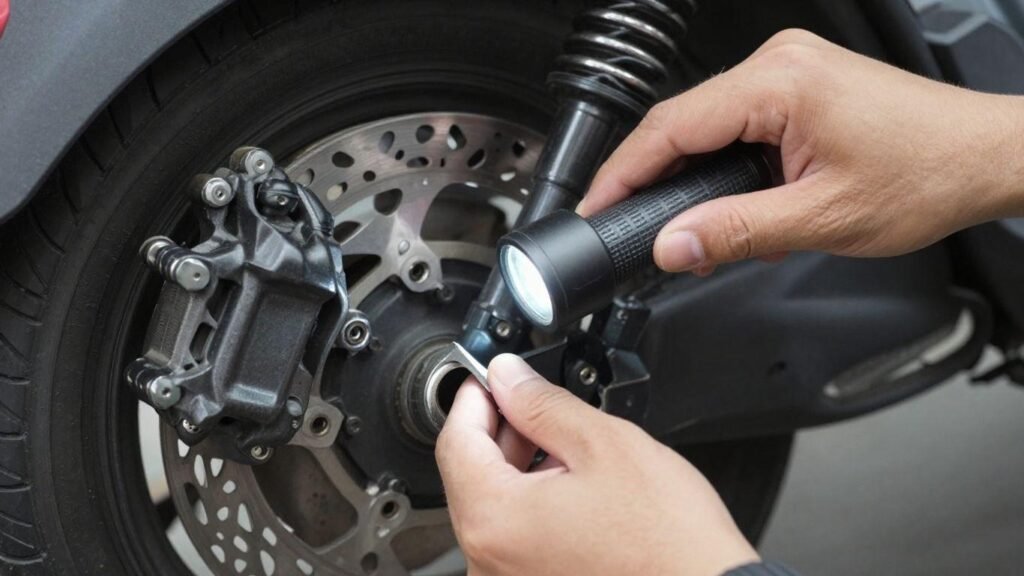
Test brake response before riding
The rider should test the brakes at walking speed in a clear area before joining traffic or descending a hill. The levers should feel predictable, and the scooter should slow without pulling sharply to one side. Any grinding, delay, pulsing, or unexpected power cut deserves attention.
The test should be repeated after rain, cleaning, wheel work, or a period of storage. Wet surfaces can change stopping distance, so the rider should leave more room until the brakes and road are dry. A brake that feels different from yesterday is a useful warning, even when it still works.
Identify worn brake pads and rotor damage
Mechanical disc systems may show pad wear, rotor scoring, contamination, or a rotor that no longer runs true. The rider should look for unusually thin pad material and listen for new scraping sounds. A rotor with deep grooves, cracks, or significant distortion should not be treated as a minor cosmetic issue.
Brake surfaces must remain free of lubricants and greasy cleaners. If contamination reaches a pad, wiping the rotor alone may not restore safe performance. The manual or a qualified repairer can identify the correct pad type and replacement method.
Adjust cable and electronic brake components
A mechanical brake cable may need inspection for fraying, kinks, or excessive slack, while an electronic brake may depend on settings or connections specific to the scooter. The rider should make only adjustments described for that model. Small changes should be followed by a low-speed test in a safe, open area.
The brake lever should not be forced past its normal travel, and electrical connectors should not be pulled by their wires. If an adjustment makes the brake feel worse, it should be reversed when safe and the scooter taken out of use. Correct operation matters more than achieving a quick home repair.
Know when brake service requires a professional
Professional service is the sensible choice when the rotor is damaged, the brake mount is loose, the cable is badly frayed, or an electronic fault persists. It is also appropriate when the rider lacks the tools or experience to secure a wheel and brake assembly correctly. Braking work has little room for guesswork.
The rider should describe the symptoms, when they began, and any recent cleaning or wheel work. That information can shorten diagnosis and reduce repeated adjustments. Until the problem is resolved, the scooter should remain parked rather than being tested in traffic.
Clean the scooter without damaging electrical parts
Cleaning removes grit that can work into hinges, wheels, and controls. It should be gentle enough to protect displays, connectors, and seals. The goal is a clean scooter with dry electrical areas, not a soaked one that looks polished for a few minutes.
Remove dirt from the deck, stem, and wheels
A soft brush can loosen dry grit from the deck, stem, wheel guards, and visible seams. A slightly damp cloth can then lift the remaining film without flooding joints or openings. The rider should clean around the wheels carefully and keep loose fabric away from moving parts.
Mud is easier to remove before it dries into a hard layer, but scraping should not gouge paint or damage cables. For stubborn dirt, a small amount of mild cleaner on the cloth is safer than spraying the scooter directly. The cloth should be rinsed often so it does not spread abrasive grit.
Protect the display, charging port, and controls
The display, throttle, buttons, and charging port need extra restraint. The rider should keep liquids away from openings and confirm that a port cover is closed before cleaning nearby areas. A dry cotton swab or soft brush can remove dust from an accessible edge.
The scooter should be powered off during cleaning, and the charger should be disconnected. No tool should be pushed into a connector to remove debris. If moisture enters an electrical opening, the scooter should remain off until it is fully dry and the issue has been assessed.
Avoid pressure washing and excess moisture
Pressure can drive water and grit past seals, into bearings, or toward electrical connections. Even a hose used from a distance can create more moisture than the scooter’s design expects. A controlled cloth-and-brush method gives the rider better visibility and fewer surprises.
The same caution applies to strong solvents, abrasive pads, and household sprays. A cleaner that works on a floor or vehicle body may damage plastic, paint, rubber, or wiring insulation. The manual’s cleaning guidance should take priority when materials or water resistance are uncertain.
Dry and inspect the scooter after wet rides
After a wet ride, the rider should wipe the deck, stem, wheel areas, and exposed fasteners with a clean, dry cloth. The scooter should then sit in a ventilated place until surface moisture has gone. It should not be placed beside intense heat to speed the process.
Once dry, the rider can check for trapped grit, rust-colored marks, loose covers, and water around the charging port. The brakes may need a gentle dry test before the next trip. Repeated wet exposure is a reason to improve storage, not to assume every seal will remain perfect.
Check the frame, fasteners, and folding mechanism
The frame carries loads from starts, stops, bumps, and folding. Small movement around the stem or latch can become a serious handling issue if ignored. A quiet inspection is especially useful after transport or riding on rough surfaces.
Tighten loose bolts and screws safely
The rider should look for fasteners that have backed out, missing washers, damaged heads, or fresh marks around a joint. Tightening should use the correct tool and a light, controlled approach rather than brute force. Over-tightening can strip threads or damage a clamp.
The manual may specify a tightening sequence or torque value for important joints. If a bolt will not hold, the problem may involve damaged threads or a missing part rather than simple looseness. The scooter should stay out of use until that underlying issue is corrected.
Inspect the stem, handlebars, and deck for cracks
Cracks, deep scratches with sharp edges, bending, or unusual gaps deserve immediate attention. The rider should inspect welds, the stem base, handlebar clamps, and the deck near mounting points. Paint can hide a developing problem, so changes in alignment or feel matter too.
The rider should not drill, glue, or weld a structural component as a casual fix. A frame problem can affect steering and folding at the same time. Photos and a clear description of the location can help a qualified service provider assess the next step.
Lubricate hinges without contaminating brakes
Only the hinge points identified by the manual should be lubricated. A small amount applied precisely is preferable to a broad spray that can migrate onto brake rotors, pads, tires, or the deck. Excess lubricant attracts grit and can make a clean mechanism dirty again.
The rider should wipe away any runoff and operate the hinge slowly several times. If the hinge remains stiff, binds, or develops side-to-side play, lubrication is not a substitute for inspection. The folding area should remain free of oil wherever the rider’s hands or braking parts may contact it.
Confirm that the folding latch locks securely
The latch should close fully and remain locked when the stem is moved gently in the normal riding direction. The rider should check for a missing pin, worn catch, loose hardware, or a latch that opens without deliberate release. This check belongs before every ride when the scooter is regularly folded.
A folding mechanism that feels loose should not be tested at speed. The rider should follow the manual’s locking sequence and seek service if the mechanism cannot hold firmly. Transport straps should never be relied on as a substitute for a locked latch during riding.
Improve performance through troubleshooting and safe storage
Performance is shaped by many small systems working together. A slow scooter may have a soft tire, dragging brake, low battery, loose connection, or mechanical resistance rather than a failed motor. Methodical troubleshooting helps the rider find the likely cause without replacing parts at random.
Diagnose common power and range problems
The rider can begin with simple observations: whether the scooter powers on, whether the display shows an error, and whether the range changed suddenly or gradually. Tire pressure, brake drag, payload, terrain, temperature, and riding speed should be checked before deeper electrical work. A fully charged battery does not guarantee the same range in every condition.
The rider should inspect the charger and port for visible damage, then consult the manual for any displayed code. Repeated shutdowns, a hot battery, or a burning smell require the scooter to be switched off and removed from service. Internal battery and controller diagnosis belongs with qualified support.
Resolve unusual sounds, vibration, and sluggish acceleration
A new sound is easier to trace when the rider notes whether it changes with speed, braking, steering, or bumps. Wheel wobble, loose fasteners, brake rubbing, bearing roughness, and debris can all create distinct symptoms. Sluggish acceleration may also follow a low charge, a riding-mode change, or a protective electrical response.
The rider should inspect the simplest safe causes first and avoid covering up a noise with lubricant. A low-speed test can confirm whether a cleaning or tightening step helped, but the scooter should remain parked if vibration worsens. Persistent symptoms call for a repair assessment rather than repeated trial rides.
Store electric scooters during long periods of inactivity
Before long storage, the rider should clean and dry the scooter, check the tires, and follow the manual’s battery charge recommendation. The storage place should be dry, moderate in temperature, and protected from direct sun or accidental impact. Folding should be done only when the mechanism is clean and locks correctly.
The scooter should be checked periodically instead of being forgotten until the next season. The rider can inspect charge level, tire condition, corrosion, and signs of pests or moisture. A gentle functional check should happen before the scooter returns to regular use.
Use replacement parts and service support correctly
Replacement parts should match the model and the component’s intended specification. The rider should keep records of repairs, error messages, and replaced items, especially when more than one symptom appears. Unverified parts can create new fit, braking, or electrical problems.
When service support is needed, a clear model number and symptom description make the conversation more useful. The rider should ask whether the repair requires a specific tool or qualified technician before removing covers. Careful support protects both the scooter and the person working on it.
Conclusion
Electric scooters perform more predictably when their batteries, tires, brakes, structure, and electrical areas receive steady attention. Short checks before each ride and deeper inspections on a simple schedule can reveal wear early. By following the owner’s manual and stopping when a fault affects safety, a rider can preserve useful performance without turning maintenance into a complicated project.