Research Dossier for Target Company: A Complete Guide to Business Research and Strategic Analysis

Introduction
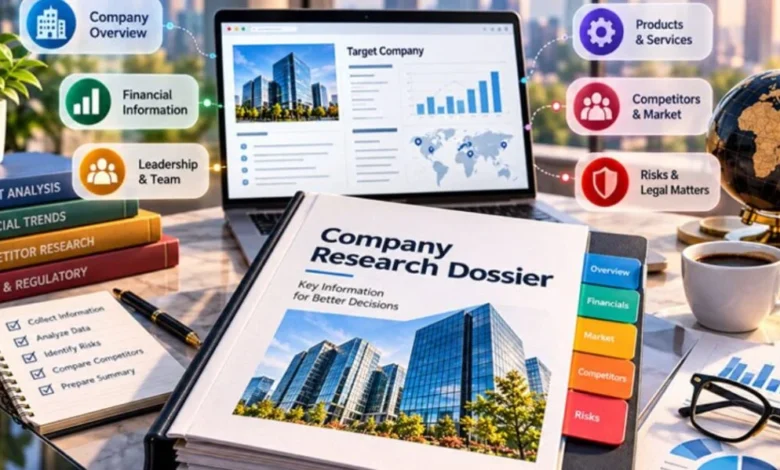
A research dossier for target company is an organized collection of information about a business that helps individuals and organizations understand its operations, financial position, market presence, strengths, weaknesses, and future potential. It provides a structured overview of a company, allowing decision-makers to evaluate opportunities, identify risks, and make informed business decisions.
In today’s competitive business environment, understanding a company before entering into a partnership, investing in its operations, approaching it as a potential client, or considering an acquisition is essential. Businesses operate in complex markets where financial performance, customer expectations, industry trends, and competitor activities can change quickly. A well-prepared research dossier brings relevant information together in one place, making it easier to assess a target company’s overall position.
Whether you are a business owner, investor, sales professional, consultant, researcher, or corporate strategist, a research dossier can help you move beyond assumptions and base your decisions on reliable evidence.
This article explains what a research dossier for a target company includes, why it matters, how to prepare one, which sources to use, and how to turn collected information into practical business insights.
What Is a Research Dossier for Target Company?
A research dossier for target company is a detailed business research document that gathers relevant facts, observations, and analysis about a specific organization. It is designed to provide a clear picture of the company’s background, business model, financial health, leadership, market position, competitive environment, and potential risks.
Unlike a basic company profile, which may contain only general information such as the company’s name, headquarters, and services, a research dossier focuses on deeper analysis. It explains what the company does, how it operates, where it stands in the market, and what factors could influence its future performance.
The exact contents depend on the purpose of the research. For example, an investor may prioritize financial statements and growth opportunities, while a sales team may focus on customer segments, purchasing needs, decision-makers, and potential business challenges.
Similarly, a company considering an acquisition may need detailed information about liabilities, ownership, legal matters, intellectual property, and operational efficiency.
The goal is to create a reliable reference document that supports a specific business objective.
Why Is a Company Research Dossier Important?
Preparing a research dossier offers several advantages for professionals who need to understand another organization before making an important decision.
1. Supports Better Decision-Making
Business decisions often involve financial commitments, operational changes, and long-term relationships. Making these decisions without sufficient information can lead to unnecessary expenses and missed opportunities.
A research dossier helps decision-makers examine relevant evidence before taking action. It provides a structured view of the company’s current position and highlights the factors that deserve further investigation.
For example, a potential business partner may appear successful based on its marketing materials. However, a detailed review could reveal declining sales, frequent leadership changes, or an overreliance on a small number of customers. These findings can influence whether the partnership is worth pursuing.
2. Identifies Business Opportunities
Research is not only about finding problems. It can also reveal opportunities that might otherwise remain unnoticed.
A dossier may highlight an underserved customer segment, a growing product category, a geographic expansion opportunity, or a gap between customer expectations and the company’s existing services.
Sales teams can use these insights to prepare relevant proposals. Investors can evaluate growth potential, while consultants can identify areas where their expertise could create measurable value.
3. Reduces Business Risks
Every business relationship carries some level of uncertainty. Financial instability, regulatory challenges, reputational concerns, and operational weaknesses can affect the success of a potential transaction.
A research dossier helps identify warning signs early. Although it cannot eliminate every risk, it provides a foundation for more careful evaluation.
The information should be verified through reliable sources, especially when the findings could influence a major investment, acquisition, or contractual commitment.
4. Improves Competitive Understanding
Studying a target company also provides insight into the broader industry in which it operates.
Researchers can compare its pricing, product offerings, customer experience, market share, and strategic priorities with those of its competitors. This comparison helps explain the company’s competitive advantages and areas where it may be vulnerable.
Key Components of a Research Dossier for Target Company
A useful dossier should be comprehensive enough to answer the important questions without becoming a collection of irrelevant information.
The following sections provide a practical structure.
1. Company Overview and Background
Begin with the company’s basic identity and history. This section establishes the foundation for the rest of the research.
Include information such as:
- Official company name and any trading names.
- Year of establishment.
- Headquarters and major operating locations.
- Industry and primary business activities.
- Main products and services.
- Ownership structure, where publicly available.
- Company size and approximate workforce.
- Mission, vision, and stated business objectives.
A brief company history can also explain major developments, including mergers, acquisitions, product launches, leadership changes, and international expansion.
Make sure the information reflects the company’s current position. Older profiles may contain outdated details about management, locations, or services.
2. Business Model and Revenue Streams
Understanding how a company generates revenue is essential to evaluating its commercial potential.
This section should explain its primary customers, value proposition, distribution channels, pricing approach, and revenue sources.
For example, a software company might generate income through subscriptions, enterprise licenses, consulting services, and technical support. A manufacturing company might depend on wholesale contracts, direct sales, and long-term supply agreements.
Researchers should also consider the company’s cost structure and dependence on particular revenue sources.
If a significant portion of its income comes from one customer, supplier, or product category, that concentration could create additional risk. Conversely, diversified revenue streams may provide greater resilience, depending on their profitability and stability.
3. Financial Performance and Stability
Financial analysis is often one of the most important parts of a research dossier, particularly when the research supports investment, lending, acquisition, or partnership decisions.
Where available, examine the company’s financial statements and relevant performance indicators, including:
- Annual revenue and revenue growth.
- Gross and operating profit margins.
- Net income or losses.
- Cash flow from operating activities.
- Debt levels and repayment obligations.
- Liquidity and short-term financial commitments.
- Capital expenditure and investment plans.
Reviewing several years of information can reveal trends that a single reporting period might conceal.
For example, increasing revenue does not automatically indicate a healthy business. If expenses are rising faster than sales or operating cash flow remains consistently weak, the company may face financial pressure.
Private companies may not publish detailed financial statements. In such cases, researchers should clearly identify the limits of the available information rather than presenting estimates as confirmed facts.
4. Leadership and Management Team
Leadership can influence a company’s culture, strategic direction, operational efficiency, and ability to respond to challenges.
This section should identify key executives, founders, board members, and other relevant decision-makers. Their professional backgrounds, previous roles, industry experience, and publicly documented achievements may provide useful context.
Researchers should also examine organizational stability. Frequent executive departures, unclear responsibilities, or major disagreements disclosed through credible sources may deserve further attention.
However, leadership changes should not automatically be interpreted as evidence of poor performance. They must be considered alongside the company’s broader circumstances.
For sales research, understanding the leadership structure can help identify the people responsible for purchasing decisions, technology investments, or strategic partnerships.
5. Products, Services, and Target Customers
A dossier should explain what the company sells and who benefits from its offerings.
Describe its primary products or services, major features, pricing categories where available, and the problems they aim to solve. Identify its main customer groups, such as individual consumers, small businesses, large enterprises, government agencies, or industry-specific buyers.
Customer concentration and customer satisfaction are also important considerations.
Public reviews, case studies, customer testimonials, and credible industry reports can reveal how the market perceives the company’s offerings. These sources should be evaluated carefully because individual reviews may not represent the broader customer base.
Understanding the company’s customers helps researchers assess whether its products meet genuine market needs and whether its customer relationships appear sustainable.
6. Market Position and Competitor Analysis
A target company cannot be evaluated effectively without considering its competitive environment.
Identify its principal competitors and compare their products, prices, market presence, customer segments, and differentiating features.
A competitor analysis may include:
- Market share, if reliable data is available.
- Brand recognition and reputation.
- Product quality and service capabilities.
- Geographic reach.
- Distribution and sales channels.
- Technological advantages.
- Recent strategic developments.
Avoid assuming that the largest company in an industry is automatically the strongest competitor. Smaller businesses may compete successfully through specialized products, better customer service, lower operating costs, or innovative technology.
Researchers can also use a SWOT analysis to summarize the target company’s internal strengths and weaknesses alongside external opportunities and threats.
How to Prepare a Research Dossier for Target Company
Creating a high-quality dossier requires a systematic process. The following steps help keep the research focused, consistent, and useful.
Step 1: Define the Research Objective
Before collecting information, establish why the company is being investigated.
Is the purpose to evaluate a potential supplier, identify a sales prospect, assess an investment, study a competitor, or support an acquisition?
The answer determines which information deserves the most attention.
For instance, a sales dossier should emphasize the company’s business needs, decision-makers, potential challenges, and possible solutions. An acquisition dossier requires more extensive financial, legal, operational, and commercial investigation.
A clearly defined objective prevents the research process from becoming unnecessarily broad.
Step 2: Identify Reliable Information Sources
Collect information from sources that can be evaluated and verified.
Useful sources include official company websites, annual reports, regulatory filings, stock exchange disclosures, business registries, reputable news publications, industry research, and public statements from company representatives.
Professional networking platforms may help identify executives and organizational structures, while customer reviews can offer supplementary information about service quality.
Whenever possible, prioritize original documents over summaries published by third parties.
Keep a record of the source, publication date, relevant finding, and date accessed. This makes it easier to verify important claims and update the dossier later.
Step 3: Organize the Information
Once the information has been collected, arrange it into clearly labeled sections.
Separate verified facts from estimates, interpretations, and unanswered questions. For example, a company’s published annual revenue is different from an analyst’s estimate of its current sales.
This distinction helps prevent assumptions from being mistaken for confirmed information.
A spreadsheet can be useful for tracking financial figures, competitors, executive details, and research sources. A written report can then explain the findings in a more readable format.
Step 4: Analyze the Findings
Information becomes valuable when it helps answer meaningful questions.
Look for patterns across financial performance, market activity, leadership decisions, customer relationships, and industry conditions.
Ask whether the company’s revenue is growing, whether its business model appears sustainable, whether it faces significant competitive pressure, and whether its strategy aligns with current market trends.
Where evidence is incomplete or contradictory, record the uncertainty rather than forcing a definite conclusion.
Step 5: Assess Risks and Opportunities
Summarize the most important positive and negative findings.
Opportunities might include expanding demand, strong customer loyalty, innovative products, or potential partnerships. Risks could include heavy debt, regulatory exposure, supplier dependence, declining demand, or reputational concerns.
Prioritize findings according to their potential impact and likelihood. This makes the dossier more practical for decision-makers who need to determine which issues require immediate attention.
Step 6: Prepare an Executive Summary
The executive summary should present the most important findings in a concise format.
It should explain what the company does, its current market position, its major strengths, its main risks, and the implications for the intended business decision.
Although this section appears at the beginning of the final report, it is usually easier to write after the research and analysis are complete.
Step 7: Review and Update the Dossier
Business information changes over time. Executives leave, financial performance shifts, products are discontinued, and competitors introduce new strategies.
Include the research date and review important sections periodically. For high-value transactions, verify critical facts again before making a final decision.
A dossier should be treated as a working document rather than a permanent description of a company.
Tools That Can Improve Company Research
Several common tools can make research more efficient and organized.
Spreadsheets help compare competitors, track financial data, and organize findings. They are especially useful when researching several companies using the same criteria.
Business intelligence platforms can provide market data, industry benchmarks, and company information. Their coverage and accuracy vary, so important findings should be checked against original sources whenever possible.
Financial analysis tools support the evaluation of revenue trends, profitability, debt, and cash flow. Public-company filings remain important for confirming reported figures.
Customer relationship management systems can organize company research for sales teams. They may store contact roles, previous interactions, business needs, and follow-up activities.
AI research assistants can help summarize lengthy documents, organize notes, and identify questions for further investigation. However, AI-generated claims should be verified, particularly when they concern financial performance, legal matters, ownership, or named individuals.
The most effective approach combines suitable tools with careful human judgment.
Common Mistakes to Avoid
Even a detailed research dossier can be misleading if the research process is poorly managed.
One common mistake is relying on a company’s marketing materials without checking independent sources. Marketing content can explain how a business presents itself, but it may not provide a complete picture of its performance or risks.
Another mistake is using outdated information. An old executive profile or financial report may no longer reflect the company’s current situation.
Researchers should also avoid confusing correlation with causation. For example, a company’s declining sales and leadership changes may occur during the same period without one necessarily causing the other.
Ignoring competitors is another weakness. A company might appear successful when examined alone but face substantial pressure from more innovative or cost-efficient rivals.
Finally, researchers should avoid including unnecessary personal information, unverified allegations, or confidential material obtained without authorization. A professional dossier should rely on lawful sources, respect privacy, and distinguish evidence from speculation.
Research Dossier for Different Business Purposes
The structure of a dossier can be adapted to suit different objectives.
For sales and business development, focus on company priorities, decision-makers, customer needs, potential challenges, and opportunities for collaboration.
For investment analysis, emphasize financial performance, valuation assumptions, industry growth, competitive advantages, and downside risks.
For mergers and acquisitions, examine ownership, liabilities, contracts, intellectual property, regulatory obligations, operational systems, and potential integration challenges. Public research is only an initial step; a significant transaction normally requires professional due diligence.
For supplier evaluation, assess financial reliability, production capacity, delivery performance, quality controls, compliance, and dependence on critical suppliers.
For competitive intelligence, study product positioning, pricing, customer segments, distribution channels, market expansion, and publicly disclosed strategic initiatives.
Adapting the dossier to its intended purpose makes the final document more focused and actionable.
What Should the Final Research Dossier Include?
A practical research dossier does not have to follow a single universal format. However, the following outline provides a useful starting point:
- Executive summary.
- Company overview and history.
- Business model and revenue sources.
- Products and services.
- Leadership and ownership.
- Financial performance.
- Market position and competitors.
- Customers and business relationships.
- Operational and regulatory considerations.
- Risks and opportunities.
- Key findings and recommendations.
- Sources, research dates, and unresolved questions.
Each section should contain information relevant to the research objective. A short dossier for a sales prospect may need only a few pages, while a major acquisition assessment may require extensive supporting documentation.
The priority should be accuracy, relevance, and clarity rather than simply producing a long report.
Conclusion
A research dossier for target company is a valuable resource for anyone who needs to understand a business before making an important decision. By combining company background, financial information, leadership details, customer insights, competitive analysis, and risk assessment, it creates a structured foundation for informed business judgment.
The best dossiers are built around a clear objective and supported by reliable, current evidence. They distinguish verified facts from assumptions, identify both opportunities and potential problems, and explain what the findings mean for the intended decision.
Whether you are evaluating a supplier, approaching a prospective client, considering an investment, or analyzing a competitor, a well-prepared dossier can help you ask better questions and use your time more effectively.
Ultimately, successful company research is not about collecting the largest possible amount of information. It is about identifying the right information, verifying its accuracy, and turning it into insights that support smarter and more confident decisions.