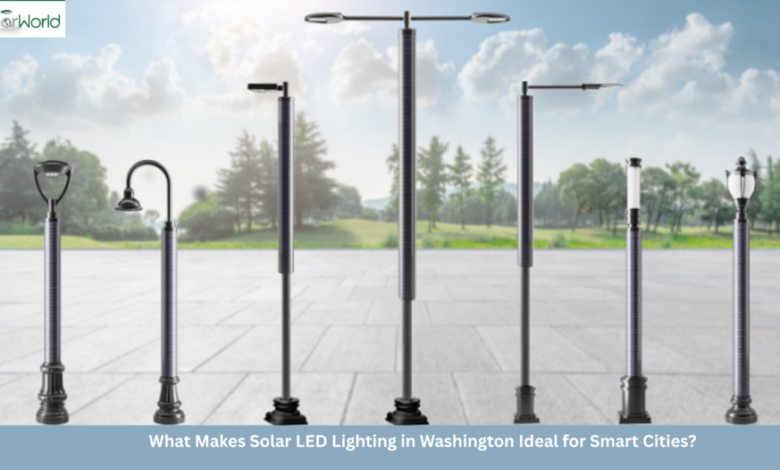
Can solar LED lighting genuinely support Washington’s growing smart city ambitions, or is it simply a sustainability talking point? It is a fair question, and urban planners, smart city managers, and infrastructure consultants across Washington State are asking it with increasing urgency. Solar LED Lighting in Washington has moved well beyond basic illumination. Today, it sits at the intersection of energy independence, connected infrastructure, and long-term urban planning.
How Can Solar LED Lighting Support Smart City Infrastructure?
Washington has always been ahead of the curve when it comes to sustainability and innovation. From Seattle’s ambitious climate commitments to smaller municipalities quietly modernising their public works, the appetite for smarter infrastructure is real and growing. Solar LED lighting in Washington fits naturally into that picture, not just as an energy-saving measure, but as a genuine platform for building connected, responsive urban environments. The question is not really whether it belongs in Washington’s smart city plans. The question is how quickly cities can integrate it effectively.
Energy Independence
Solar LED systems operate entirely off the grid, generating and storing their own power. For Washington cities managing large public lighting networks, this means freedom from utility rate fluctuations and protection against outages that would otherwise leave streets and public spaces dark.
Reduced Infrastructure Costs
Traditional street lighting requires extensive groundwork, trenching, cabling, and ongoing grid connection fees. Solar systems eliminate most of that upfront expenditure, freeing budget for other infrastructure priorities without compromising on lighting quality or coverage.
Connected Pole Architecture
Modern solar poles are not just light sources. They are designed from the ground up to carry additional technology sensors, cameras, communication equipment, and monitoring systems, turning each installation point into a multi-purpose urban asset rather than a single-function fixture.
Adaptive Lighting Controls
Smart solar lighting systems can be programmed to adjust brightness based on time of day, foot traffic, or specific conditions. This kind of responsive control reduces energy consumption further while improving the experience for residents using public spaces after dark.
Scalable Deployment
Washington cities vary enormously in size and complexity. Solar LED systems are built to scale, starting with a single corridor or parking area and expanding across an entire district without requiring infrastructure redesigns or compatibility overhauls at each stage.
Solar LED lighting in Washington, in short, gives Washington’s urban planners a platform they can actually build on. It is not a standalone solution; it is the foundation for something considerably more ambitious.
Can Solar Lighting Power IoT Sensors and Public Connectivity Networks?
This is where the conversation really opens up for smart city teams. The ability to mount and power additional technology on solar poles transforms what would otherwise be a simple lighting upgrade into a genuine infrastructure investment. Across Washington, urban planners are beginning to recognise that the pole is just the starting point.
Environmental Monitoring Systems
Solar poles can host air quality sensors, noise monitors, and environmental data collectors that feed real-time information back to city management platforms. For Washington municipalities with strong environmental commitments, this turns street lighting infrastructure into an active part of their sustainability monitoring network, gathering data continuously without drawing a single watt from the grid.
Public Wi-Fi and Broadband Connectivity
Connectivity gaps remain a genuine challenge in parts of Washington, particularly in lower-income urban neighbourhoods and rural-adjacent communities on city fringes. Solar poles equipped with broadband capability can serve as access points, extending public Wi-Fi coverage into areas that traditional infrastructure has historically underserved. It is a practical step toward digital equity that does not require a separate, costly deployment.
Collection of Data on Traffic and Pedestrians
The intelligent poles may be equipped with sensors that track the movement of traffic and pedestrians in real time. It becomes an asset for the transport planners of Washington to have such live information, especially when making decisions about traffic light timings and safe street designs.
Emergency Communication Infrastructure
In a region that takes emergency preparedness seriously, solar poles offer something traditional infrastructure simply cannot: reliable operation during grid failures. Emergency communication equipment mounted on solar LED lighting in Washington stays active precisely when it is needed most, supporting public safety systems even when the broader power network goes down.
The through-line across all of these applications is the same: solar poles do more than light streets. They give Washington cities a distributed, resilient network of infrastructure points that can carry the technology of today and adapt to whatever comes next.
How Does Solar LED Lighting Help Future-Proof Urban Infrastructure?
Urban infrastructure decisions made today will shape how Washington’s cities function for the next thirty years. That is a long time, and the pace of technological change makes flexibility non-negotiable. Solar LED lighting in Washington is built with that reality in mind, they are not static installations but adaptable platforms designed to evolve alongside the cities they serve.
Here is what makes them genuinely future-proof:
- Modular infrastructure design allows cities to add capability to existing poles without full replacements, protecting the original investment as needs change over time.
- IoT-ready pole architecture means new sensors, cameras, or communication devices can be integrated as the technology matures and becomes relevant to city operations.
- Broadband expansion support gives municipalities a physical network already in place when connectivity programmes are ready to scale across neighbourhoods.
- Grid-independent operation ensures that future grid pressures, rate increases, or supply disruptions do not affect the performance or reliability of public lighting.
- Retrofit compatibility allows solar upgrades to work with existing pole infrastructure, making it financially realistic for cities of all sizes to modernise without starting from scratch.
Future-proofing is not about predicting exactly what Washington’s cities will need in 2040. It is about building an infrastructure flexible enough to meet those needs when they arrive.
Conclusion
Solar LED Lighting in Washington is no longer a niche sustainability choice it is a practical, scalable foundation for smart city development. From powering IoT sensors to supporting public broadband and emergency systems, the right solar infrastructure does far more than illuminate streets. For urban planners and smart city teams ready to build Washington’s next chapter, it is one of the most sensible places to start.